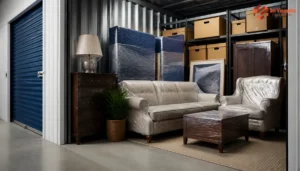
Most people will rent a first storage unit while shifting house, remodeling, or expanding their business, and the assumption is always the same: if it can go in the door, it can go into storage. That assumption is exactly what causes most of the trouble.
A self-storage unit is an empty box, unattended, and often exposed to changing air and humidity. You may return to it after several weeks, and in India, where monsoons keep the air humid for much of the year, the wrong item may not just rot itself—it may transfer dampness, odour, and pests onto everything stored around it.
So understanding what not to put in a storage unit is less about rules and more about the common sense you used when buying your possessions in the first place.
What Should You Not Put in a Storage Unit?
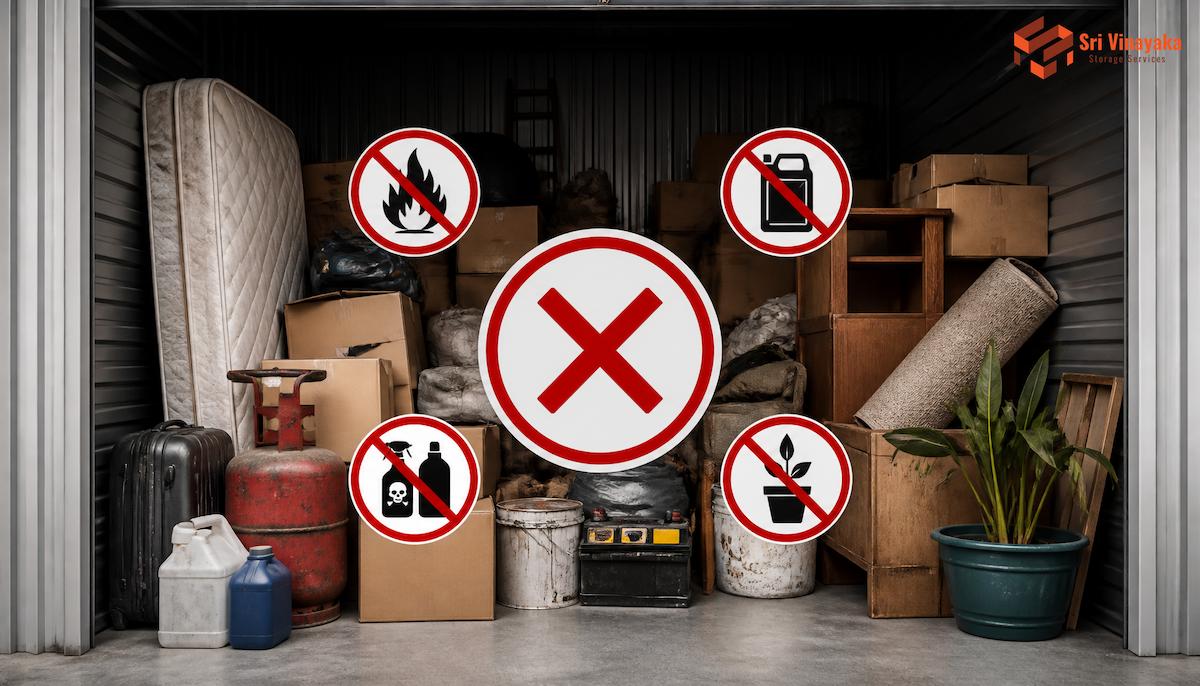
The short answer is anything that causes a fire hazard, causes damage, is living, is perishable, or is moisture-prone. The default blacklist for a storage facility is shaped by fire safety, insurance rules, and simple common sense. No flammable liquids are allowed because a shared facility means one spark can endanger the entire property—and such losses are usually not covered by insurance. No food is allowed because it can attract rats within days.
What Are the Most Commonly Prohibited Items?
The table below outlines the most commonly prohibited items.
Category | Typical examples | Why it is prohibited |
Flammable, explosive, and dangerous goods | Petrol, kerosene, paint thinner, LPG gas cylinders, fireworks, ammunition and cartridges, compressed gas, lithium battery packs, acids, pesticides | Fire and explosion risk; danger to adjacent units; voids insurance. |
Perishable food and edibles | Fruits, vegetables, milk and dairy products, bakery items, meat, fish, poultry, condiments, spices, prepared food | Decomposes rapidly, ferments, supports bacteria, mould, and pests, and attracts insects and rodents. |
Living things | Pets, animals, plants | Require sunlight, air, water, and daily maintenance; violate comfort and cleanliness rules. |
Illegal or stolen goods | Stolen goods, illegal drugs, unlicensed weapons, counterfeit stock | Illegal; subject to immediate removal and possible police action. |
Wet, damp, or unwashed garments/canopies | Wet mattresses, unwashed work clothes, unclean kitchen appliances, garden tools covered with dirt | Mould and fungal growth, odour, pest infestation, and damage to nearby items. |
Strong-smelling items | Untreated leather, fuel-soaked equipment, industrial chemicals | Odours pass between units and contaminate other goods. |
Vehicles transporting fuel and loose tyres | Fuel in the vehicle, engine leaks, stacked tyres | Leakage, fire risk, and permanent oil staining. |
What Should You Keep Out Even If It Is Allowed?
A handful of things are actually accepted yet still a foolish choice. Original property deeds, jewellery, and cash, passports, wills, and family photographs should stay at home or in a bank locker, not in a metal unit that you see twice a year. The same applies to anything you could not replace or would be devastated to lose. A storage unit will handle clutter; it will not stop theft, flooding, or fire—and a rental contract will not fully compensate you for an heirloom. Using this list as a guideline, not a bother, is the key to keeping your contract and your possessions in good standing.
Which Is Not Allowed in Storage? Understanding Facility Rules
It is a little different when it comes to the next one, because it is about the contract, not personal preferences. Whatever the agreement says is prohibited is what is prohibited, and the agreement is what you can rely on.
In India, self-storage agreements include a prohibited-use clause prohibiting certain dangerous materials, foods, living things, illegal items, and anything that would turn the unit into a house or repair shop.
Even rules at facilities differ—some allow broken-down furniture and bikes, while others prohibit pumps and tyres. A few minutes spent reading the agreement before signing will save a large bill—if not a costly lawsuit.
What Happens If You Store a Prohibited Item?
- Your lease may be terminated. If you violate the prohibition against illegal or immoral use, it is a material breach of the lease. The operator has the right to give you short notice and request that you vacate immediately. You are liable for rent until the unit is vacated.
- Your insurance cover could be invalidated. Most policies will not cover damage caused by items that were never allowed in your unit. Your insurance claim for damage from leaking fuel can be refused.
- You may be responsible for other people’s losses. Storage units are packed so tightly that a problem in one unit can easily affect another. If chemicals in your storage unit start a fire or seep into a neighbouring unit, you may be sued for the damage caused.
- You could get yourself into trouble. Storing stolen property, unlicensed firearms, or drugs is a criminal issue, not just a contractual one. Facilities will work with the police, and the repercussions may be far worse than losing your rental deposit.
Everyday Items People Wrongly Put in Storage
Almost all bad storage decisions are not illegal; they are simply uninformed. Two of the most common offenders are electronics and clothing: both are permitted in the unit and stored by virtually everyone, and both require particular conditions to last more than a few months—and humidity is the unspoken villain in both.
Will a TV Be Okay in a Storage Unit?
Yes, a TV can be stored—just make sure you keep moisture and temperature under control. Condensation can build up inside the unit, affect circuit boards, damage backlight panels, and make the set uneconomical to repair. Heat can warp components, while cold can cause contraction damage.
Most storage units are located in unshaded industrial areas, so a climate-controlled unit or an indoor unit is the best choice for a flat screen.
Retain the original box and foam fillers. Most television boxes are built for this exact purpose and will fit the screen without putting pressure on it while protecting the set from impact. Buy a rigid double-walled carton with corner padding if you no longer have it.
Store it vertically, never horizontally. Flat-mounted screens are much more likely to crack when being transported or when anything is placed on top of them. Storing it upright ensures even pressure on the panels.
Wrap it with anti-static or bubble film plus silica gel. Anti-static plastic protects against static electricity damage. Silica gel absorbs moisture when the box is closed and prevents humidity from building up inside over several weeks.
Never set it directly on the ground: a concrete floor pulls moisture into the box from beneath and will be the first place to show water after rain. Set it on a pallet or raised wood.
Should You Vacuum Seal Clothes Before Storing Them?
Here is a counterintuitive one: do not vacuum-pack clothes for long-term storage. Natural fabrics need some air; if vacuum-pumped and stored for about three months, they can lose tensile strength, crease permanently, and yellow badly.
For a move or a few weeks, vacuum bags are fine, but for a year or more in storage, breathable cotton covers, acid-free boxes, and cedar blocks provide a better environment. Avoid cardboard boxes for clothing altogether, as they absorb humidity and other contaminants.
What Are Common Storage Unit Mistakes?
The errors that hit tenants hardest are rarely big. They are long streaks of small choices that quietly chip away at the value of everything in the unit. They all come down to fifteen minutes of forward thinking.
Packing, Placement and Planning Errors
These packing, placement, and planning errors are preventable.
- Not creating a list of the contents. If you do not write one and keep it taped to the inside of the door, you will forget where you put things within weeks. The list is also handy when claiming insurance for damaged items.
- Stacking heavy things high. Heavy items should go low; lighter boxes go on top. This reduces the risk of collapse and makes the unit safer to move around in.
- Putting boxes directly on the floor. Contact with the floor allows moisture to move into cardboard and then into your belongings. Use pallets or planks under the first layer.
- Blocking the doorway and aisle. If you cannot walk through the doorway and reach the back wall, you will stop checking the unit—and any damage may go unnoticed for months.
- Booking the wrong size storage unit. Units that are too small lead to poor stacking, while oversized units waste money. Measure your belongings roughly before you book so you can pick the perfect size.
Storing the Right Way With Sri Vinayaka Storage Services
Rules and checklists can only get you so far—the rest is up to the storage facility itself to ensure that your things survive. A facility that is well-maintained, clean, dry, and checked regularly can eliminate a lot of the risk this article has laid out.
Why Renters in Bengaluru Choose Professional Self Storage
Sri Vinayaka Storage Services offers safe, clean premises with secured access and flexible monthly storage options to accommodate house shifts, renovation breaks, and business inventory. Our crew will advise you on items that may not be stored in your storage unit before you sign, so you don’t end up with a lease violation instead of a smooth storage experience.
Quick Glance: What Not to Put in a Storage Unit
Your One-Minute Checklist
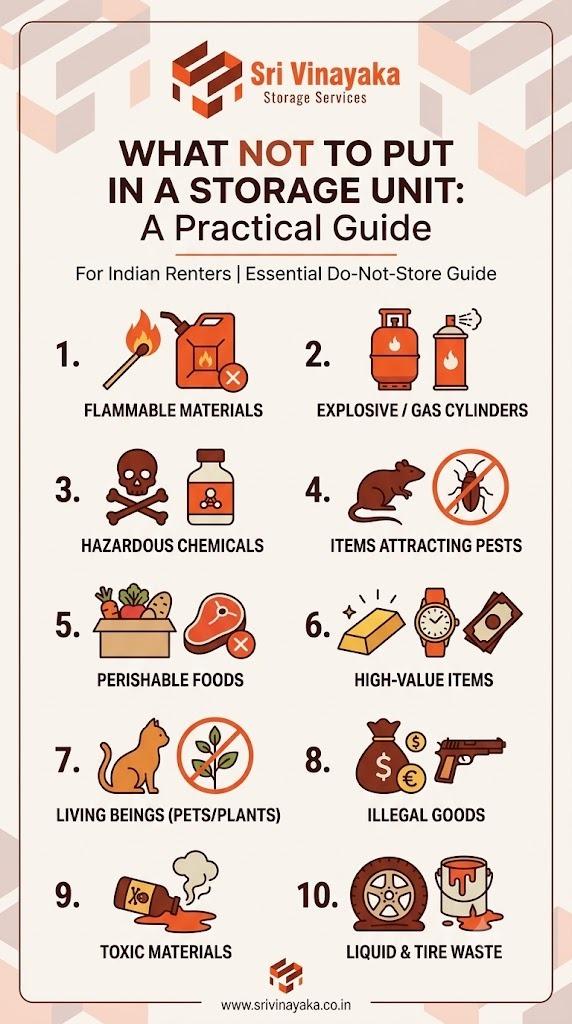
- No flammable liquids, gas cylinders, fireworks, or ammunition.
- No food, spices, packaged edibles, or pet food.
- No pets, livestock, or plants.
- No counterfeit stock, stolen property, unlicensed firearms, or drugs.
- No items that are damp, unwashed, or covered in soil.
- No strong-smelling chemicals or fuel-soaked equipment.
- No fuel in vehicles and no loose stacked tyres.
- No cash, jewellery, original documents, or irreplaceable family heirlooms.
Final Thoughts
Storage units are not the place for everything you cannot make up your mind about. It is the innocent-looking vacuum bag of woollens, the sealed carton of spices, and the sticky old damp mattress that are the real danger.
Declutter those before you pack, and your life will be a peaceful one. Want to know what you can keep in storage in Bengaluru before you commit? Then reach out to a pro at Sri Vinayaka Storage Services for advice on rules and regulations, and to find a space that actually works for what you want to store.
FAQs
Can I store a fridge or washing machine in a storage unit?
Yes—but not without some preliminary care. Both should be thoroughly defrosted, drained, and dried (a build-up of water inside promotes rusting and mould). When stored, they should be kept upright, preferably with the door slightly wedged open to allow circulation.
Can I run a small business or workshop from a storage unit?
You may be able to keep business stock, tools, or materials there, but in most cases you won’t be able to carry out your work in the space itself. This tends to be a safety or fire-control issue.
How much does a self-storage unit cost in India?
The rent in India for a smaller unit begins at a few thousand rupees per month (approximately $40 USD) and increases as size, location, and level of access go up. Climate-controlled and indoor units command higher rates, but are a valuable investment for electronics, documents, textiles, and other high-value items.
What should not be stored in a self-storage unit long term?
Any object that is humid or temperature-sensitive should not be stored in a long-term uncontrolled unit—untreated wood, unpadded artwork, photographs, musical instruments, and electronics will deteriorate over time. If you have to do this, select a climate-controlled unit and open or inspect it every once in a while.