Indian families every summer pack away woollens and winter quilts. When many of these families open these boxes after the monsoon, they get a real shock seeing that the articles are moth-eaten, fabric is musty and cardboard is damp. After being kept unused for months in a cupboard, garage or warehouse, such items can sustain more damage from things like dust, moisture and pests, than from normal use.
Stored items protection is the one method that can help you keep away damage from dust, moths, and pests, which would ultimately save your belongings, money and precious memories. Whether you are storing items at home or in a professional facility like Sri Vinayaka Storage Services, understanding how to protect your valuables is essential. For those requiring professional assistance, our storage facilities are designed to provide comprehensive protection for all your belongings.
What Does Stored Items Protection Involve?
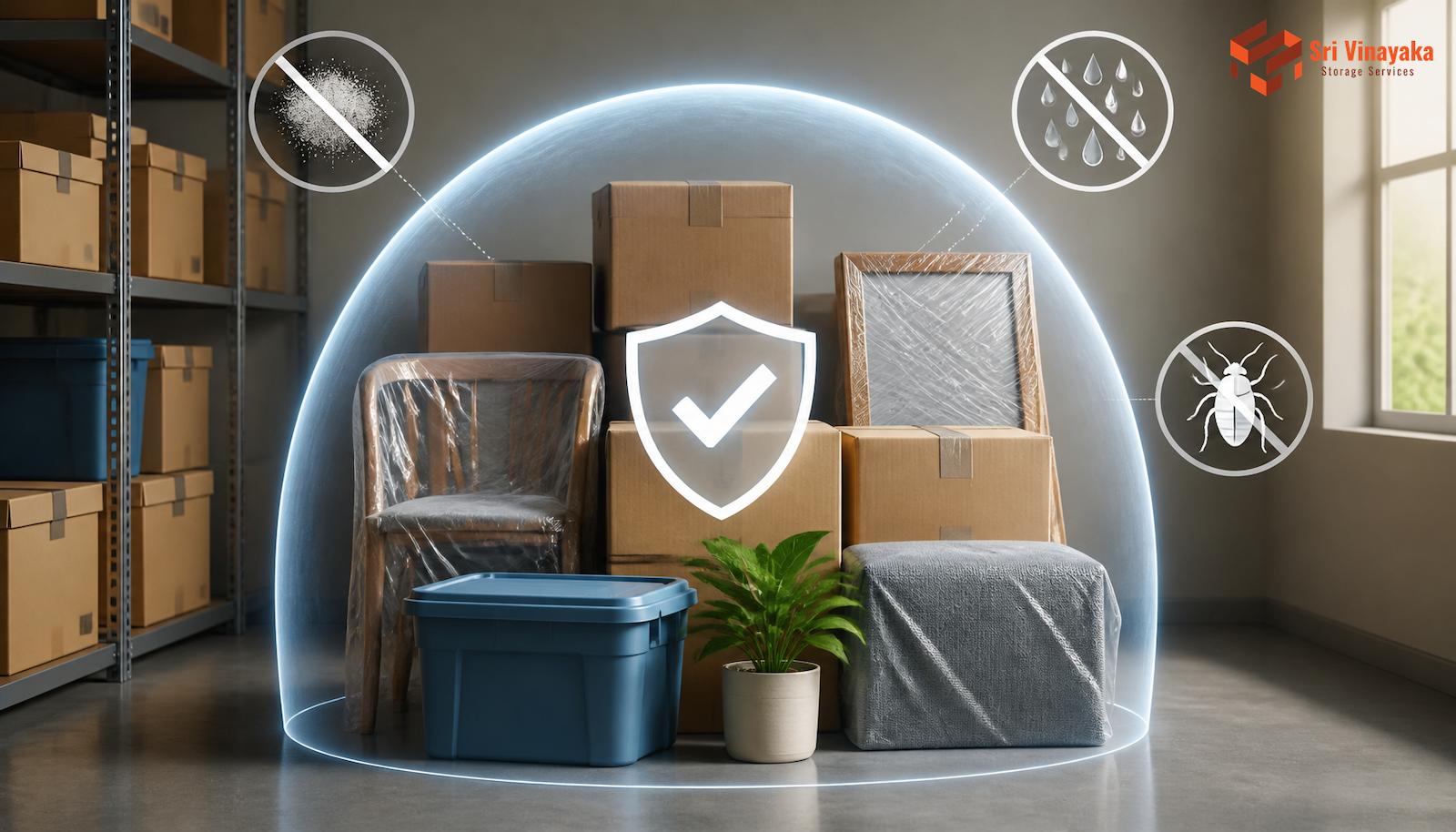
Stored items protection mainly entails the guarding of clothes, furniture, documents, and electronics from three types of damage sources: dust, pests, and dampness. Dust makes surfaces and fabrics progressively dull and weak, while humidity promotes mold, mildew, and rust. Also, bugs such as cockroaches and silverfish will be delighted to chew almost any type of fabric or wiring.
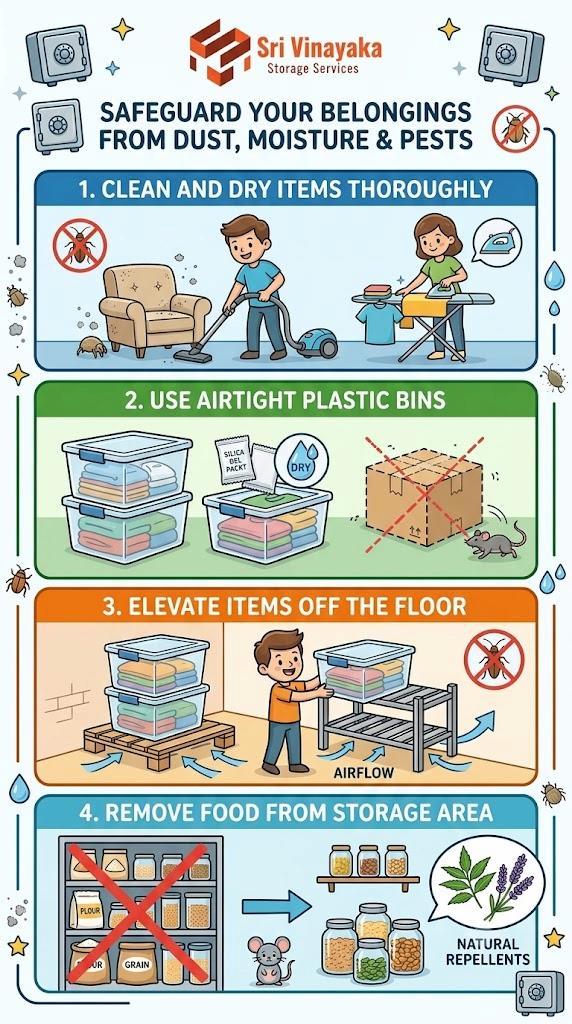
The basic idea is that storing items properly prevents the problems in the first place, and there is no need for the problems to get worse to the point that you will actually require some kind of fix. So you need to give a thorough clean and also completely dry up all items prior to taking them out, choose containers which are tightly sealed to stop any penetration of pests and air moisture.
You should put boxes on the wall or shelves to avoid being near the ground as this may promote the growth and the attraction of pests. It is always recommended to not have food beside the rest of your property. Even in a normal room when you practice these habits you can rest assured your belongings will stay safe and untouched despite getting the worst treatment.
This is why storage centers which offer professional storage will adopt these storage concepts for all their customers who have high expectations on the safety of their things. Our safe storage in Bangalore services follow these very principles to ensure complete protection.
Why Is It Important to Prepare Items Before Storing Them?
In a very large proportion of storage-related infestation issues, the problem actually starts even before the storage box is sealed. For example, a piece of clothing left with its soiled condition can result in its harboring of dust mites and food stains, the presence of moisture in a fabric can cause mold spores. And, wood furniture not being kept clean will be the target of wood borers.
Little cleaning at this point is very helpful in making the protection that one applies to stored items much more efficient after storage. If you are planning to use household storage services, proper preparation becomes even more critical to ensure your items remain in pristine condition throughout the storage period.
Wash and Dry Clothes and Furniture Before Packing
Clothing needs to be properly washed, thoroughly dried and well-ironed to eliminate moth eggs which are difficult to kill by ordinary washing. To woolens, one may put neem leaves or cedar blocks into the bag as they provide a very good moth repeller.
A thorough vacuuming of furniture is very important to make sure that no crumbs or hair become food and attract pests during storage. For comprehensive guidance on protecting your furniture, refer to our furniture storage guide which covers everything from wooden pieces to upholstered items.
Keep Food Out of the Storage Area
Rice, flour, sugar, cookies, and candies are all attractants for weevils, cockroaches, and rats, regardless of whether the food remains in sealed bags or plastic packages. Food odour permeates into storage areas that have rodents running loose and it might cause the invasion of the entire storage area.
Even if it is essential for you to store rations nearby, you ought to place them on separate shelves in air-tight jars at a safe distance from clothes, documents, and electronics. This separation is particularly important when using self-storage units where multiple types of items may be stored together.
How to Store Dry Goods to Prevent Pest Infestation?
Indian kitchens often have problems with weevils, rice moths, and flour beetles, mainly during humid months, when you try to store the dried goods.
The pest problems get worse when grains are in the plastic bags with holes, or are in the containers not totally sealed with the lid properly closed.
Transfer all dry goods to clean, airtight containers right after buying the ingredients so that they are stored in containers rather than your shelves.
1. Freeze Flour and Grains for 24 to 48 Hours
If you buy flour, pulses and cereals for grinding, keep the whole packages or portions frozen for 24 to 48 hr periods. The eggs, larvae and even the adult stage forms of insects present in newly bought flour, grain or pulses are all killed by putting the item in the freezer for a day or two before you store it on your shelves so that your pantry doesn’t get infested by them.
2. Place Bay Leaves Inside the Containers
Two or three dry bay leaves in every container of rice, dal or wheat have been proven to repel most insects. They are quite a safe bet because these strong-smelling leaves won’t spoil the food.
3. Add Oxygen Absorbers for Long-Term Stocks
Pests love a constant flow of air. So, adding oxygen absorber sachets to sealed containers removes the oxygen that pests depend on for survival. Without oxygen, not only can the adult pests not reproduce, the insect eggs too, cannot hatch. The container is, in effect, virtually insect-proof.
For those considering long-term storage in Bangalore, these methods are especially valuable as they provide sustained protection over extended periods.
What Smell Do Pests Hate the Most?
Odor plays an important role in the life cycle of many pests. Smearing lavender and peppermint oils over small pieces of cotton placed in the corners of containers will keep a lot of them at a distance. Cedar blocks plus neem leaves are a good combination to drive away the insects living on clothes folds, while placing bay leaves in containers of grains can be very effective in keeping the weevils away. These natural repellents are most suited for the Indian context as they are both cost-effective and chemical-free besides being safe to use near children and pets.
Why Are Sealed Plastic Bins Better Than Cardboard Boxes?
Cardboard boxes have a tendency to get damaged and weakened because they are susceptible to moisture mostly during the monsoon as well as they offer silverfish and cockroaches excellent places to hide. Sealed plastic containers that on one side can prevent the access by teeth and that also prevent the entry of moisture as well as dust are this way much more desirable. Transparent plastics would be even more beneficial as you would have the luxury of spotting any early signs of moisture or pests without needing to open up your stored items box by box!
For those using full-service storage solutions, the choice of containers becomes less critical as professionals handle the packing with appropriate materials designed for maximum protection.
Keep Stored Items Off the Floor and Away From Walls
Rats and insects generally travel alongside walls and floors which is the reason why if your stored items are placed on the ground they should be discovered and even targeted. Moisture can also be taken up from the ground and the bottom layers of the cartons get spoiled because of this.
To avoid it, you can keep all cartons on wooden or metal pallets and raise them from the wall by keeping a small space between the carton and the wall. It is not just the protection of your goods against termites that is the benefit of the latter practice but it also increases good air circulation, helps the inspection process and reduces the risk of termite entry.
If you are considering professional options, our storage facilities in Bangalore are designed with proper elevation systems and pest prevention measures already in place.
The 5-Point Stored Items Protection Checklist
- Clean, dry and iron every fabric before storing it.
- Use airtight plastic bins with silica gel pouches, not cardboard boxes.
- Keep food in sealed containers, away from other belongings.
- Elevate all boxes on pallets or racks and keep them away from walls.
- Inspect the storage space monthly and refresh natural repellents.
For a more detailed approach to organizing your storage space, you might find our guide on packing and organizing a storage unit extremely helpful.
Even though it is not a pleasure to hear, the truth is that dust, damp and pests do not leave, so your protection routine against insects also never leaves! At Sri Vinayaka Storage Services, besides offering clean, secure and pest-managed spaces we make sure that all the stored household and business belongings are given a proper environment for their protection while in storage. Our commercial storage services and personal storage services are tailored to meet diverse requirements with the highest safety standards.
FAQs
How to Get Rid of Stored Product Pests?
If you discover a stored product pest infestation discard the infected food packets or damaged items after identifying them, because leaving even one item would enable the reoccurrence of the problem. After that you should clear the place and you can either dust the shelves with a cloth or use a vacuum cleaner but it would be better to give them a hot soapy wash.
Introduce sealed containers, bay leaves and regularly scheduled inspections so pests won’t have the chance to make their home back in. For more comprehensive advice on choosing the right protection methods, read our guide on questions to ask about self-storage before renting.
What Are 5 Ways to Prevent Pests?
- Kick-off the cleaning routine by making sure the storage area is kept neat.
- All your stored foods should be in airtight containers only.
- Minimize clutter so that pests won’t have the opportunity to hide in it.
- Boxes should rest above the floor so that pests will not come from there.
- There is an additional layer of prevention with natural pest repellents like neem, cedar, and peppermint oil that you can also consider.
Can Cardboard Boxes Attract Pests in Storage?
Of course, cardboard boxes can mean pest problems in storage since they hold up moisture quickly, become very weak, and are a kind of hiding spot for pests.
If the use of cardboard boxes is mandatory, avoid putting them on the floor and instead cover them with plastic sheets. To understand more about what items are suitable for storage, check our article on things that are not allowed in storage facilities.
How Often Should I Check My Stored Items?
Much to the satisfaction of many storage service providers, a regular check of your stored products is very easy and does not cost anything if you know what to look out for.
So at least once a month, and preferably even more frequently during monsoon months, look into your storage room for signs of wetness, broken packages, small particles or smells that resemble rotten vegetables as these would be the first indicators of the problem developing. For those using professional services, our storage experience ensures that regular monitoring and maintenance are part of the service. You can also read our tips on 5 useful tips for a better long-term storage experience to maximize the safety of your belongings.