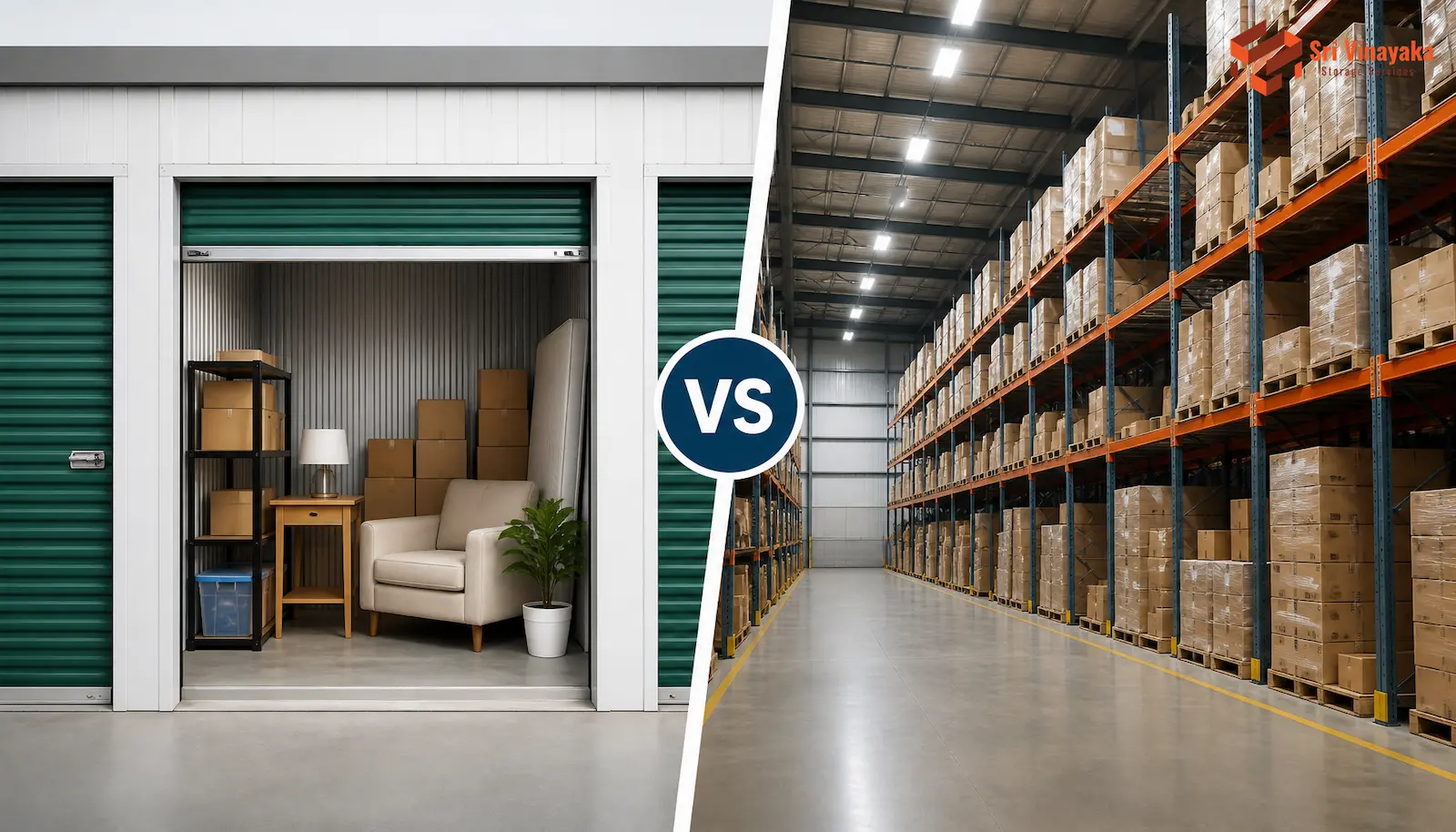
Household expansions in Bengaluru and even small businesses on top of excess stock, they always land face to face with the same question – where are the goods going to be kept at, a self-storage unit or into a warehouse?
Honestly, these products are very different from each other and are intended to store different volumes of goods. Most people simply consider three elements in the comparison: scale, control and commitment. This article will explain each aspect, clarify what they mean, and it will finish with a practical checklist that you will be able to use before signing any document.
What Is the Difference Between Self Storage and Warehouse Storage?
A warehouse is a facility that is operated as a business and that stores goods in large quantities. Usually, palletised goods are handled and stored on storage racks, and the goods are handled by an operator instead of the owner.
Then again, self-storage refers to renting a secure private lockable unit on a monthly basis, and you lock it using your own key. Besides, self-storage is the perfect choice when you need to store something for a short while. It’s a kind of space for personal belongings or business goods that require quick access.
Warehousing and Storage Meaning: What Is Warehousing?
Warehousing is the business of keeping large quantities of goods in a big industrial warehouse, where you find storage racking, handling machines, etc., and where records of your stock are kept. Generally, a warehouse is involved in workflows like the receipt of goods, storing them, retrieving, packing, and dispatch.
Such tasks are mostly controlled via a WMS (warehouse management system) or are outsourced to a 3PL partnership. Unlike a plain storage unit, a warehouse offers a service as well as a place – a third party could handle incoming goods on your behalf, count them, and take them back on your behalf.
Storage Unit
The storage unit is just the physical area in a self-storage building, usually a small 5X5 ft locker to a 10X10 or 10X20 ft unit with drive-up, ground floor units, with some facilities offering climate-controlled units ideal for storing sensitive goods. For rent of the storage unit (in rupees), you pay a monthly fee and you can use any lock you like.
The rest, that is, the safety and security with the storage facility are up to the operators who are supposed to manage access control systems and have cameras installed for surveillance. As Sri Vinayaka Storage Services has a number of storage units of varying size, it is very likely that such a person will be able to lease a unit suitable in size to accommodate his/her family needs for a short-term basis without having to commit to a warehouse.
This basic knowledge sets a basis for the entire self vs warehouse storage debate – if you are able to visualize whether your merchandise belongs to the “unit-sized” category or “pallet-sized” category then you will understand how the decision can change in a minute.
Key Differences Between Storage and Warehouse
The simplest and most effective way to highlight the difference between a storage and a warehouse facility is to look at the factors which either increase your expenses or limit your flexibility.
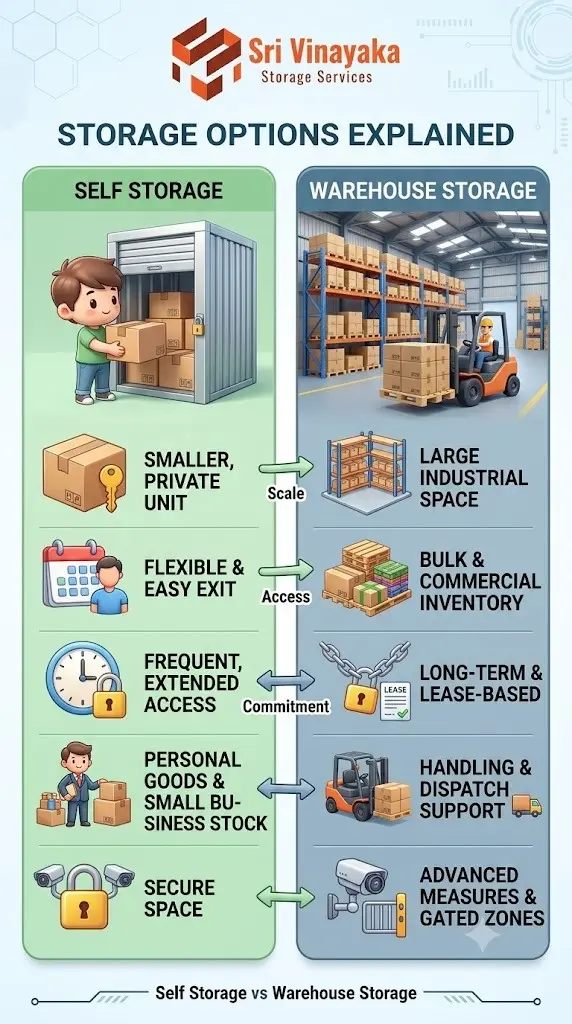
Factor | Self Storage | Warehouse Storage |
Space | Smaller, private unit | Large industrial space |
Purpose | Personal goods, small business stock | Bulk and commercial inventory |
Duration | Short-term, flexible | Long-term, lease-based |
Commitment | Monthly rent, easy exit | Lock-in period, notice terms |
Access | Frequent, often extended hours | Business hours, operator-managed |
Security | Access control, CCTV | Advanced measures, gated zones |
Services | Space only | Handling, pick and pack, dispatch |
Scalability | Add another unit | Renegotiate lease |
What Are the Three Main Types of Storage Facilities?
In India, most of the providers can be categorised as three kinds of storage facilities and knowing which one you need will save you from overpaying:
- Self storage units — Secure, private lockers and rooms rented monthly to households and small businesses, usually in urban neighbourhoods. Goods are packed in boxes and stacked, not palletised. Sri Vinayaka Storage Services operates in this category.
- Warehouse or commercial storage — Large facilities usually with pallet racks, loading bays and inventories for distribution, etc., for traders, manufacturers and e-commerce sellers. Normally space is available on long-term lease or through a third-party logistics arrangement. You can explore commercial storage services for this model, and learn more about industrial storage racks in larger facilities.
- Bonded and specialised storage — Customs-bonded warehouses storing imported goods for which tariffs haven’t yet been cleared plus temperature-controlled refrigerated storage units for storing food and medication items. These are subject to stringent requirements under Indian customs and GST regime. For sensitive goods, see this guide to climate-controlled storage facilities.
What Does ‘Warehouse Storage’ Mean?
Storage of goods within a commercial big-sized facility is usually carried out using pallets and by the operator who also takes care of receiving, putaway, storage and dispatch activities. Since warehouse storage is meant for commercial volumes, it is usually equipped with different types of racking systems, docking facilities, forklifts, and even inventory tracking systems besides just offering a simple lock and key security arrangement.
What Are the Three Types of Warehouses?
- Private warehouse — Owned or exclusively leased by one company, giving full control over layout, security and stock handling, but with high fixed cost.
- Public warehouse — Space rented by the pallet or square foot from an operator, ideal for seasonal spikes and businesses that cannot justify a full lease.
- Bonded warehouse — Licensed by customs authorities to store imported goods before duty payment, allowing deferment of duty until clearance.
Several new-day operations even opt to contract or 3PL warehouses and automated warehouses, where warehouse staff (or sometimes even a robotic warehousing system) will have picking and dispatch responsibilities.
How Does Warehouse Storage Work?
The mechanism of warehouse storage is fairly standard across facilities, and understanding it helps you judge whether a warehouse suits your goods at all.
- Inbound receipt — Goods arrive by truck, are unloaded at the dock and counted against the invoice or packing list.
- Putaway — Items are assigned a rack or bulk location and recorded in the inventory system, often via WMS and barcode scanning.
- Storage — Stock occupies pallet positions awaiting an order, cycle counts periodically are done to maintain accurate records.
- Picking and packing — Ordered SKUs are picked up, then they are sorted into boxes and labelled as a result. After that, a staff member or a contractor will pack them and prepare for delivery.
- Dispatch — The goods are loaded onto the trailer and the delivery is made and inventory updates happen in real time while delivery documents are prepared automatically.
Storage and Warehousing in Logistics
Logistically speaking, storage and warehousing act as buffers against the demand for supplies. They help consolidate, unload part of the products, cross-docking, and last-mile distribution. Due to this, a warehouse located near a highway or an urban periphery is as important as the amount of racking capacity the warehouse has. A small seller, for instance, with a self-storage facility located near the city will be able to buffer with the warehouse for a much smaller cost compared to the warehouse itself.
Final Checklist for Choosing Self Storage or Warehouse Storage
Below are some considerations which you can bear in mind as to whether you choose self storage or warehouse storage:
- Goods fit in boxes, not pallets: choose self storage.
- You need frequent access and your own lock: choose self storage.
- You want a monthly commitment, not a multi-year lease: choose self storage.
- You are moving pallets, truckloads or SKUs in hundreds: choose warehouse storage.
- You need handling, pick and pack or dispatch support: choose warehouse storage.
- Your goods are imported and awaiting duty: choose a bonded warehouse.
Conclusion
When you are at the point of making a decision, it is better if you look first at your requirements and comfort level. The self vs warehouse storage decision will no longer be something that you find confusing in case you assess your volume, what sort of access is needed, and with which kind of commitment you will be comfortable.
In short terms: Self storage is the best match for domestic users and local businesses since it gives you a locked and secure environment, and it also allows you to make the rental payment as and when you please month on month. But, the ideal situation for using warehouse storage is in cases where a company deals with the movement of goods in commercial lots and the operations require handling as well as fulfilment.
Sri Vinayaka Storage Services is one such service provider that focuses only on the first kind, that is self-storage, which it offers with clean units, secured against theft, suitable for personal items and even the stock of small businesses. In this way, you can increase or decrease your space without feeling the pressure of a lease being in place.
FAQs
Self storage vs warehouse storage: what's the difference?
Most commonly, the answer in such public discussions is about self storage being a private area rented by the month, whereas a warehouse is the large storage place for the commercial goods with the operator-handling operations only.
Is self storage cheaper than warehouse storage?
The unit rate is much more for the self storage, but you just have to take space you need, so the monthly payment is definitely a lot less than warehouse leasing. Self storage can be less expensive than warehouse storage when you consider that, although the per square foot costs of self storage are higher, you do not pay for empty space, and the amount you pay monthly tends to be only a small portion of the cost of a warehouse lease. Self storage is also a good cost-effectiveness for business inventory management: if you need a storage solution for a short period, it is best to go with self storage, whereas for a long-term need, it is warehouse storage that will be your better option. For pricing context, compare storage space costs in Bangalore.
Can I store business inventory in a self storage unit?
Yes, it is actually a common practice for some small business owners and traders in India to store their goods in self storage units and to go when needed. It is fine with the company as long as it is neither poisonous nor spoilable.
What is the main difference between storage service and warehousing service?
Storage service is the renting of a space, and the user will handle everything else himself. On the contrary, warehousing service is not only the renting of the space but also the provision of various services such as material handling, inventory maintenance, and shipment. This is the reason that one is the lease of an individual unit and the other is the lease of a pallet or a warehouse space.