In India’s diverse climate, where summer temperatures can soar past 40°C and monsoon humidity levels cross 80%, protecting your valuable possessions during storage becomes a real challenge. Whether you are shifting homes, decluttering, or storing business inventory, the weather can silently damage your electronics, wooden furniture, important documents, and antiques.
This is where climate controlled storage comes to aid. Unlike normal storages, godowns or self-storages, these climate controlled storage facilities keep the humidity and temperature constant all over the year. In this blog, you will get all your questions on climate-controlled storages answered, i.e. from how it works to which things require the most protection, with special emphasis on Indian cities like Bengaluru and others.
What Is Climate Controlled Storage and How Does It Work?
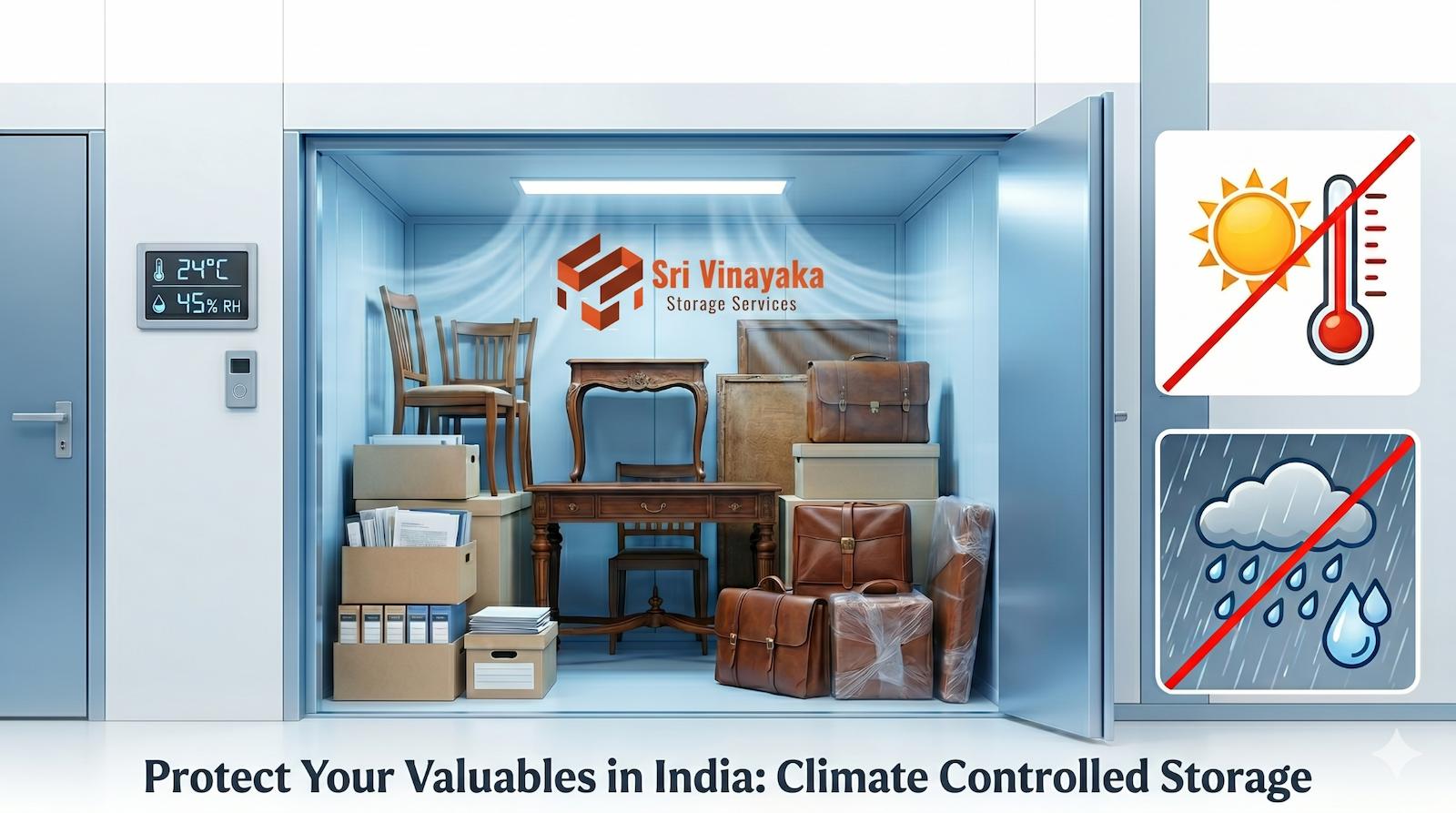
Climate controlled storage is an indoor storage area that maintains a constant temperature and humidity level throughout the year. Most of the time the temperature hovers between 13 degree C to 29 degree C.
What Temperature Is Climate Controlled Storage Maintained At?
The majority of climate controlled storage facilities tend to keep their temperature between 18-29 degree C.
The reason is that most household and business items are preserved best within this temperature range. More than 30 degree C at times and adhesives in furniture start melting. However, less than 10 degree C makes some plastics brittle. These temperature levels maintain the life of electronics, vinyl records, leathers and furniture regardless of the summer peak or the peak of monsoon.
How Does Humidity Regulation Protect Your Belongings?
Humidity is also important – in Indian cities like Mumbai, Chennai and Bengaluru, the relative humidity in the air is generally greater than 70% during monsoon conditions.
Clients offering climate controlled storage will even have HVAC units constantly filtering and circulating the internal air, using effectively dry air (defined as between 30 & 50% relative humidity, determined by the client preference) to prevent fungus, mold, rust, warping, yellowing, etc. in the stored object.
What Items Need Climate Controlled Storage Units the Most?
Not all possessions need climate control storage, but some items that are worth more than certain others and are more delicate surely do. The premium that will likely be due (anywhere from Rs.1500- 4000 more every month, according to the size of the unit), will be well spent when you compare it to the amount we spend when we replace a broken computer or a missing ancient table.
Electronics and Appliances
The sensitive circuit board and components of a home theatre system, TV Laptop, Desktop computer, camera, or gaming console can be damaged by either high heat or high humidity. High heat can result in cracked solder joints and high humidity can cause corrosion and short circuits. Climate controlled storage units protect against both of these conditions so your electronics still work on arrival.
Wooden Furniture and Antiques
Solid wood furniture will expand when humidity rises and will contract with dry heat resulting in cracks, splits, crooks, and loose joints. Old wood and finishes are even more susceptible. Properly humidified storage will ensure your dining tables, wardrobes, wood boxes, and family heirlooms keep their shape for years.
Important Documents and Artwork
Paper is hygroscopic, so it draws moisture from the air around it. Humidity causes paper to become limp with ink running and mold forming. In dry heat the paper can become brittle with the paper turning yellow.
Original paintings, photographs, notarial and legal documents, diplomas and religious texts need to be kept in a climate controlled setting. Most of the places that will hold documents for storage provide document storage boxes to fit into a climate controlled storage unit.
Leather Goods and Fabrics
Leather Jackets, Bags, Shoes, Upholstery etc. develop mildew patches and cracks on exposure to change in moisture content. Besides these, wedding dresses, silk saris, woollen sweaters and costly curtains also require a damp free environment. Climate control also avoids the musty smell and deterioration in fabric that results when stored in conventional compartments.
Temperature Controlled Storage Facility vs Standard Storage – Key Differences
Indians often are asking themselves if paying more for a temperature controlled storage facility makes sense.
This table clearly states the difference and makes a comparison of the available climate-controlled units vs. standard (non-climate-controlled) storage in most of the areas.
Feature | Climate Controlled Storage | Standard Storage |
Temperature Range | a more steady environment since it has a lower annual temperature range (18C to 29C). | Same as outside (0C to 45C+) |
Humidity Control | Relative humidity 30-50% | No control (20-90% based on weather). |
Unit Location | Within insulated buildings | Most probably will be day shelters, lead sheds or uninsulated godowns. |
Air Circulation | Ongoing HVAC air filtration | Almost no. |
Protection From | The parasite host environment consists of air, water, and soil. The major pollutants in our environment are: | Basic security and protection from the rain |
Ideal For | Electronics, wood, documents, antiques leather | Other plastics, tools made of metal, Business stock not sensitive |
Cost per month (100 sq ft) | Rs.3000-Rs.5000 | Rs.1,500-Rs.2,500 |
As the table indicates, standard storage, although less expensive, allows your sensitive possessions to be vulnerable to the severe seasonal fluctuation in India. For storing lesser valuable items for less than 3 months, the standard units are suitable. But when storing for more than 3 months i.e. long-term, or vulnerable possessions, climate-controlled units are a better choice.
Indoor Climate-Controlled Storage – Why Indoor Facilities Are Superior
An indoor climate-controlled storage unit is one that is completely within a building and not exposed to any outside air. This differs quite a bit from an outdoor, “drive up” unit that just has a climate control unit placed within a metal garage.
The Building Envelope Advantage
The rooms are equipped with insulated walls, sealed roof, weather-stripped doors and good quality flooring (keeps moisture out and away from the temperature). This practice known as having “building envelope” minimizes the work of the air conditioning system (by not constantly battling against the outside heat or cold).
This can make for a more stable temperature and humidity, reduced energy costs (and as a result reduced cost of your rent) and reduced exposure to dust/dirt, insects and rainwater.
Enhanced Security and Convenience
Since indoor units are in the building, they inherently come with an extra security layer. Many climate controlled indoor facilities take even more measures than the outdoor units to safeguard themselves by having facility access by keycard or biometric sensor and then your individual unit requires a key or numerical entry.
A locked padlock on the outdoor units is much easier to crack than your two factor internal security system. Indoor units are generally easier to access, more clean, well lit and cool (or warm) with dangerously hot or cold weather.
Quick Glance – Is Climate Controlled Storage Right for You?
Before deciding, use this checklist to decide if it is worth investing in climate controlled storage facilities:
- The items have to be stored for more than 6 months
- Your possessions include electronics, computers or appliances that heat and humidity are enemies of.
- You have wooden furniture, antiques or instruments these warp and crack as the moisture content varies.
- Documents, photographs, art, or books – paper deteriorates quickly outside of controlled surroundings.
- Fabrics such as leathers, silk sarees, woollens, wedding dresses etc. – all of these will develop mold and musty smells.
- You live in a place which is humid (Mumbai Chennai Calcutta), arid (Kolkata) or has extreme Summers (Delhi, Nagpur)
- The items which have been stored are either of high value economically or sentimentally or both.
Answering YES to three or more of these indicates that climate controlled storage would be advisable.
Conclusion
Taking care of your prized possessions, including your furniture, is not a matter of choice if they are to be kept for a long time. Environments with unpredictable temperature variations and excessive moisture need not even be considered as a feasible storage option when you have access to climate controlled storage units.
Store right through the year makes no difference with these units as the temperature remains constant. Many people want to find climate-controlled storage units near them that implement a worry free approach to storing their belongings.
If so, look for a storage company that offers indoor units, clear pricing, high security and reliable HVAC systems. Sri Vinayaka Storage Services brings years of experience together with today’s best climate controlled storage and you’ll have a perfect partner for your family and business anywhere in India. Don’t end up throwing your valuables out because of the heat, humidity or dust. Choose climate control and relax.
FAQs
What is the cheapest way to get storage in India?
The least expensive option for storing items in India is to rent a regular (non-climate-controlled) storage unit (around Rs1,000 to 2,000/month).
lesser cost options are:
- sharing a larger unit with others like family, friends or neighbors,
- using portable storage containers for shorter durations (up to 3 months),
- and negotiating a longer term discount (over 6 months).
For certain high-value or sensitive items such as computers or documents, the cheapest option may be more costly for replacement or repair costs. Always weigh the value of items being stored.
What are the four types of storage facilities available in India?
The four main storage options in India are:
- Self Storage Units- personal or small business individual storage units, from small to climate controlled storage units
- Warehousing- commercial storage for large quantities of inventory (Does not have to be climate controlled)
- Portable Storage containers- weather resistant containers that are delivered to your home or office, you store what you want, then call to have it picked up
- Vehicle/Boat Storage- To be exact designed space for autos, motorcycles or RV’s (sometimes climate controlled)
Can I store food items in climate controlled storage?
Nom most climate controlled storage facilities do not allow perishable foods as they attract pests, produce odours and can spoil in a climate-controlled unit, even if they are stored in a locked container inside it.
In general, sealed non-perishable foods are not a problem, like canned food or boxed goods, but always read your rental agreement carefully. If you need a cold storage unit to store food long-term, a dedicated facility is best.
How much does climate controlled storage cost in Indian rupees?
Prices differ by city, size of storage unit and provider.
- If you have a small-sized 50 sq ft unit (just enough for 10-15 cartons), the monthly bill could be as low as Rs.1,800 and go up to Rs.3,000 per month.
- They go up to around Rs.3,000 – Rs.5,000 for a 100 sq ft medium-sized unit.
- Up to Rs.5,500 – Rs.9,000 for a 200 sq ft large-sized unit.
Premium facilities come with extras like 24-hour access, climate control and insurance will be costlier. Always check if there are any hidden costs in your bill to avoid surprises!
Is climate controlled storage necessary during winter months in India?
Though Indian winter is not as harsh as the western countries, during night in Delhi, Jaipur and Chandigarh temperature may fall down to 2-5 degree C.
Such low temperatures during winter with fog and condensation can affect delicate products such as electronics, paints, glues and plastics. Climate controlled storage will keep the internal temperature unaffected by outside temperature, Because of this even it will be advantageous in winter.